
Lessons in Leadership: Inside the AIC Public Safety Leadership Academy
Lessons in Leadership: Inside the AIC Public Safety Leadership Academy
Insights from the Line of Duty
When one of his officers was killed in the line of duty in 2018, Yarmouth Police Chief Frank Frederickson found himself responsible for every aspect of the crisis that followed, from coordinating the criminal investigation and media response, to supporting grieving family members and officers.
These are lessons not typically taught in traditional police academy training. Frederickson had to learn them on the job, and fast. As an instructor with the AIC Public Safety Leadership Academy at American International College, the now-retired chief shares what he learned about leadership, grief, and holding a law enforcement agency together through crisis, helping to prepare other public safety leaders to navigate a line-of-duty death, while hoping they never have to.
Inside the AIC Public Safety Leadership Academy
Hosted by American International College (AIC) in Springfield, Massachusetts, the Public Safety Leadership Academy is a one-week professional development program for law enforcement supervisors and aspiring leaders. The academy focuses on public safety leadership training, emphasizing decision-making, command presence, accountability, communication, and emerging challenges in policing.
The curriculum includes legal liability, crime scene command, internal affairs, artificial intelligence in policing, behavioral science, and other core areas of modern law enforcement leadership development.
The program is taught by experienced law enforcement professionals like Frederickson, who now serves as Director of Governmental Affairs for the Massachusetts Fraternal Order of Police and Executive Director of the New England Association of Chiefs of Police. He is also an advocate for fallen officers and their families.
Training Leaders for Crisis Response
In the opening session of the AIC Leadership Academy, Frederickson recounted the day 32-year-old Sergeant Sean Gannon was shot and killed during a police operation. His K9 partner, Nero, was also shot but recovered after surgery and later returned home with Gannon’s widow.
The chief held his first press conference just three hours after the shooting but cautioned students not to rush statements to the media. “Do it on your own timeline,” he said. “And make sure you get the details right. When a police officer is murdered, there is a sense of fear among the public.”
A major source of support came from what Frederickson called his “brother chiefs” — fellow law enforcement leaders who provided backup through relief coverage, escorts, and peer support. They also rallied around Gannon’s colleagues, helping officers navigate the difficult days that followed.
In his final remarks to the class—all leaders in the Springfield Police Department—Frederickson said that even having lived through such an experience, managing a traumatic event in law enforcement leadership is never straightforward. Every situation is different, he said, but there are common lessons. This is why he draws on the events surrounding Gannon’s death as a case study in crisis leadership.
The experience has shaped much of Frederickson’s work in the years since. He has become a leading advocate for policies supporting officers and families after line-of-duty deaths and catastrophic injuries. He also works to promote legislation focused on officer safety and wellness. As part of that effort, he said, “I’d love to see the state come up with policies around line-of-duty deaths.”
For Springfield Police Sergeant Matt Longo, Frederickson’s presentation provided valuable insight into leadership during a crisis. Longo, who recently earned his bachelor’s degree through AIC’s criminal justice degree completion program, said the lesson broadened his understanding of what effective law enforcement leadership looks like during such an event.
“I’ve never been in that type of situation, so it was interesting to hear about the coordination of resources that went into it,” Longo said. “Being here and getting this training will help me be better prepared as a leader.”
Crime Scene Training in Practice
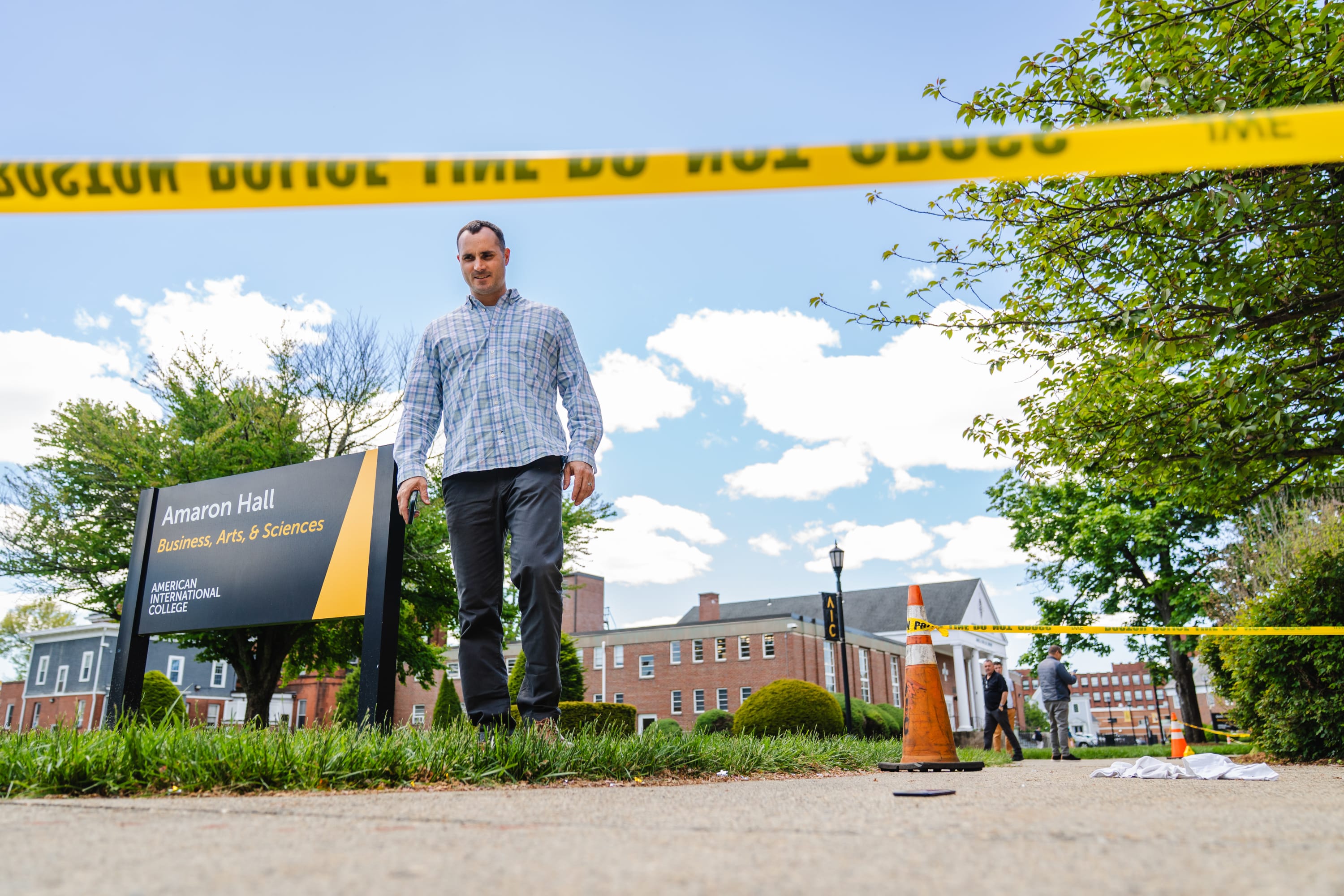
In the second session, the focus shifted from crisis leadership in crisis to the mechanics of crime scene investigation. Behind a perimeter of yellow crime scene tape, officers were introduced to the fundamentals of crime scene preservation and evidence documentation through a hands-on training exercise.
Officer Eddie Pena of the Boston Police Crime Scene Response Unit and a faculty member in AIC’s Criminal Justice degree completion program guided participants through each step of the process. He emphasized clear, thorough documentation—avoiding blurry images, taking more photographs rather than too few, and preserving the integrity of the scene from start to finish.
Pena echoed Frederickson’s comments that this type of public safety training offers lessons officers do not typically receive in traditional police academy instruction. “At the police academy, there’s little to no crime scene training," he said. “We know to photograph a crime scene, but how do we do it?”
As the training progressed, participants continued building supervisory and leadership skills for modern law enforcement. Sessions covered legal considerations around use of force, privacy and arrests, behavioral supervision, and training practices. Officers also explored the growing role of artificial intelligence in policing—one of the most significant shifts in contemporary public safety leadership.
The Ripple Effect of Leadership Training
With the first academy complete, instructors were already preparing for four additional cohorts scheduled for the summer, including three week-long sessions in August.
Pena said one of the academy’s greatest strengths is its ripple effect. “All of the supervisors who participate will return to their departments and share their newfound knowledge,” he said. “So other officers not in attendance will also receive the benefit of this training.”
To learn more about the AIC Public Safety Leadership Academy, contact Michael Stevens, Assistant Professor of Criminal Justice, at michael.stevens@aic.edu.
Images
Additional Info
Media Contact : Denise Vozella